Roller
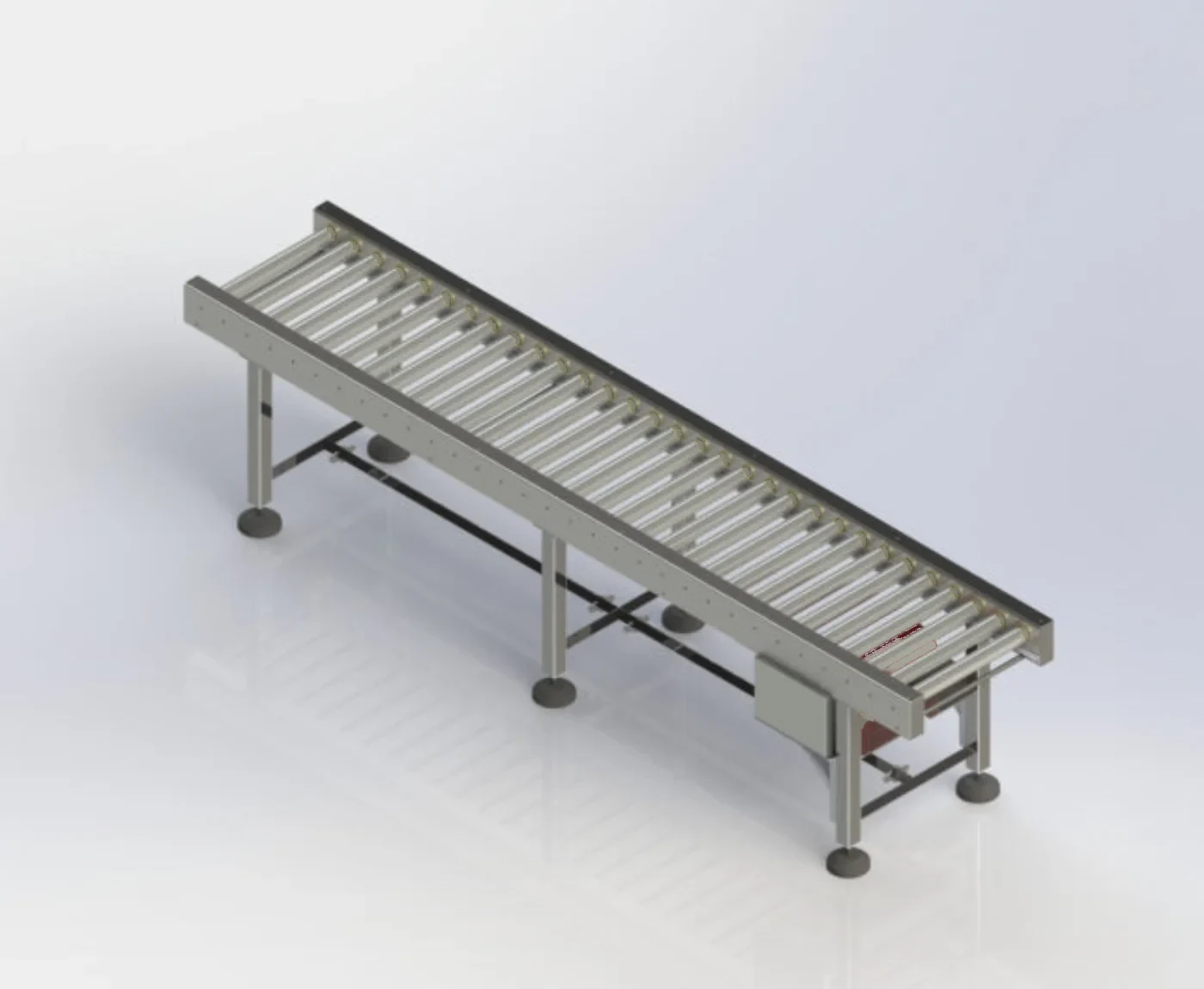
Roller conveyors, gravity and powered, for cartons, totes and pallets.
Free-running gravity and driven power-roller conveyors, including radius turns and zero-pressure accumulation for buffering and staging heavier unit loads.
Also known as: roller conveyor system, roller track conveyor, industrial roller conveyor.
Pick the type that matches the layout
The family fixes the belt, the frame and the duty. The type fixes the geometry — straight, curved, inclined, spiral or vertical. Width, drive, finish and controls are set per application on the general arrangement drawing.
Roller conveyors, explained
What is a roller conveyor?
A roller conveyor carries unit loads with a firm, flat base, such as cartons, totes, crates and trays, on a bed of rollers set across the frame. In a gravity roller conveyor the rollers turn freely, and the load moves on a slight fall or by hand. In a powered roller conveyor a motor drives the rollers through chain, belt or cord, so loads travel at a set speed on the level and can be stopped, spaced and queued. Rollers suit heavier unit loads, not loose or very small products that would drop between them.
Gravity or powered roller conveyor?
Gravity roller has no motor, so it is the lowest-cost option for manual pushing, picking stations and spurs off a main line. A powered roller conveyor holds a controlled speed of 3 to 20 m/min, and the radius version carries the load round a turn of 500 to 1500 mm radius. An accumulation conveyor holds a queue at zero pressure, so products wait without pushing on each other. That lets it absorb a stoppage downstream without stopping the line upstream.
What sizes and materials are standard?
Powered roller conveyors are 300 to 1000 mm wide, with 38 to 60 mm rollers. Gravity roller runs up to 1500 mm wide, and accumulation conveyors up to 1200 mm. Frames are stainless steel SS 304 or mild steel, with SS 304 or SS 316 for accumulation. Mild steel is painted or powder-coated, and stainless is matt or bead-blasted. Powered types run on 220 V or 415 V, at a working height of 700 to 900 mm.
Can a roller conveyor be built to our layout?
Yes. Every KFlexiTrack conveyor is built to the application, not picked from stock. The work starts with a study of the product and the line, then a layout, GA drawings and a 3D CAD model, all signed off before a single sheet is cut. Lengths, widths, heights, drive side and finish are set to your floor, and the frames are cut, bent, machined and welded in-house in Goa. KFlexiTrack then installs, aligns and commissions the line on site and trains the operators.
Does KFlexiTrack supply conveyors outside India?
Yes. KFlexiTrack supplies customers across India and exports conveyors abroad. Every machine is designed, built and run-in at the works in Ponda, Goa before it is dispatched. For an export enquiry, send the product, the rate it has to move at, the floor plan and the destination country through the contact page, or message the works on WhatsApp at +91 93258 43201.
What does a quote need, and how long does it take?
Send the product, the rate it has to move at, and the floor plan. From those, KFlexiTrack comes back with a layout, a specification and a price, normally within five working days. Product photos, drawings and the machines the conveyor has to meet all shorten the first reply. For anything urgent, call the works on +91 93258 43201. After hand-over, spares, preventive maintenance and retrofits are handled for the life of the machine.
Drawn before it is cut
Application study, layout and general arrangement drawings are produced in-house for every type in the family, then the machine is fabricated, run-in and commissioned on the same drawing.
The rest of the range
5 families cover 22 standard types. If the duty does not sit in this one, it usually sits in one of these.